
Singapore’s work visa landscape is evolving rapidly, shaped by shifting demographics, global competition, and Singapore’s long-term economic priorities. As a licensed Employment Agency (EA License: FA20190141) and Full-Service Travel Agency (TA03256), RSBU Group regularly advises entrepreneurs, investors, and families navigating these changes – from visa applications to relocation logistics and full business setup. Our insight into regulatory developments allows us to provide a clear, practical view of how the system is shifting and what applicants can expect in 2026.
Like most countries, Singapore is grappling with a shortage of qualified workers in its economy.The country that once defined openness through efficiency is now defining it through purpose. In 2025, Singapore introduced one of the most comprehensive talent-policy recalibrations in its history: salary benchmarks were lifted, new evaluation frameworks like COMPASS took full effect, and the focus shifted from quantity to quality.
Every year or two, depending on evolving needs, the Ministry of Manpower (MOM) publishes a list of strategic occupations enduring the most acute shortages of qualified workforce – the Shortage Occupation List (SOL), which has just been updated for 2025. The list reflects an array of professions across Singapore’s several strategic sectors: food, healthcare, green economy, and technology, with highly specific roles in the maritime sector and financial services catering to the growing number of ultra-wealthy residents who have descended on the city-state in recent years.
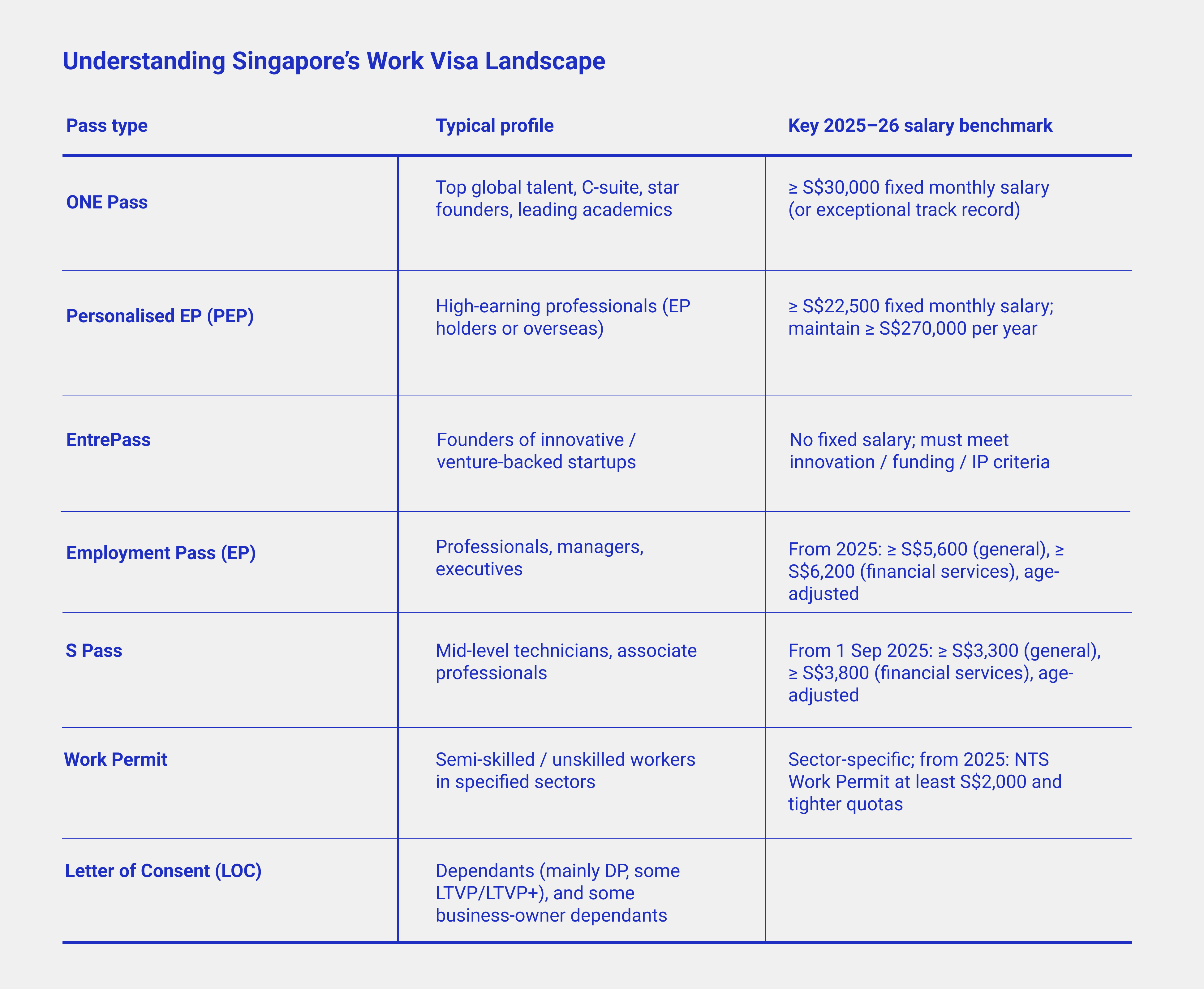
Singapore already operates a well-defined multi-tier work pass system. At the top, premium passes such as the Overseas Networks & Expertise Pass (ONE Pass) and the Personalised Employment Pass (PEP) continue to attract global founders, investors, and C-suite executives. Below that, the Employment Pass and S Pass have become more demanding, requiring employers to prove genuine business substance, local hiring, and economic contribution. Even Work Permit policies have been refined to favour longer-term integration over rapid rotation.
Like most countries, Singapore is grappling with a shortage of qualified workers in its economy.The country that once defined openness through efficiency is now defining it through purpose. In 2025, Singapore introduced one of the most comprehensive talent-policy recalibrations in its history: salary benchmarks were lifted, new evaluation frameworks like COMPASS took full effect, and the focus shifted from quantity to quality.
Every year or two, depending on evolving needs, the Ministry of Manpower (MOM) publishes a list of strategic occupations enduring the most acute shortages of qualified workforce – the Shortage Occupation List (SOL), which has just been updated for 2025. The list reflects an array of professions across Singapore’s several strategic sectors: food, healthcare, green economy, and technology, with highly specific roles in the maritime sector and financial services catering to the growing number of ultra-wealthy residents who have descended on the city-state in recent years.
Singapore already operates a well-defined multi-tier work pass system. At the top, premium passes such as the Overseas Networks & Expertise Pass (ONE Pass) and the Personalised Employment Pass (PEP) continue to attract global founders, investors, and C-suite executives. Below that, the Employment Pass and S Pass have become more demanding, requiring employers to prove genuine business substance, local hiring, and economic contribution. Even Work Permit policies have been refined to favour longer-term integration over rapid rotation.
Overseas Networks & Expertise Pass (ONE Pass)
The ONE Pass sits at the very top of Singapore’s talent stack. It targets global leaders in business, technology, arts & culture, sports, academia and research who want flexibility to live and work in Singapore without being bound to a single employer.
Core eligibility in 2025:
1. Salary route
You must have earned a fixed monthly salary of at least S$30,000 (or equivalent) for the 12 months preceding the application, or will earn at least S$30,000 under a Singapore employer.
The employer must be an established company – meaning a firm with a market capitalisation or valuation of at least US$500 million, or annual revenue of at least US$200 million (globally, not only in Singapore).
2. Outstanding achievements route
Applicants with an exceptional record in sports, arts and culture, academia, or research may qualify based on professional achievements, subject to joint assessment by MOM and relevant agencies such as A*STAR or MCCY.
Validity and renewal
The pass is issued for up to five years and can be renewed for subsequent five-year periods. To qualify for renewal, the holder must either:
Key advantages
Who it suits
C-suite executives, hedge-fund managers, global entrepreneurs, and leading academics who seek long-term flexibility and independence in Singapore rather than an employer-linked Employment Pass.
Core eligibility in 2025:
1. Salary route
You must have earned a fixed monthly salary of at least S$30,000 (or equivalent) for the 12 months preceding the application, or will earn at least S$30,000 under a Singapore employer.
The employer must be an established company – meaning a firm with a market capitalisation or valuation of at least US$500 million, or annual revenue of at least US$200 million (globally, not only in Singapore).
2. Outstanding achievements route
Applicants with an exceptional record in sports, arts and culture, academia, or research may qualify based on professional achievements, subject to joint assessment by MOM and relevant agencies such as A*STAR or MCCY.
Validity and renewal
The pass is issued for up to five years and can be renewed for subsequent five-year periods. To qualify for renewal, the holder must either:
- Have earned an average of S$30,000 per month in Singapore over the past five years, or
- Have founded and actively operated a Singapore-registered company employing at least five local employees each earning at or above the EP qualifying salary.
Key advantages
- Freedom to work for multiple employers, act as a founder, investor, or advisor without separate approvals.
- Exempt from COMPASS, foreign-worker quotas, and levies.
- Spouses on Dependant’s Passes may obtain a Letter of Consent to work.
Who it suits
C-suite executives, hedge-fund managers, global entrepreneurs, and leading academics who seek long-term flexibility and independence in Singapore rather than an employer-linked Employment Pass.
Personalised Employment Pass (PEP)
The PEP is aimed at high-earning professionals who want flexibility to change jobs within Singapore without re-applying for a new EP each time.
Eligibility criteria
Applicants may qualify through either of the following routes:
Unlike the ONE Pass, the PEP does not require the employer to be an established company, but it does require evidence of stable, high income.
Validity and conditions
Failure to meet these conditions will result in cancellation of the pass.
Advantages
Limitations
Who it suits
Senior executives or professionals earning S$22,500 or more per month who value employment mobility and mid-term residency flexibility in Singapore – for instance, regional directors, consultants, or global specialists working across multiple markets.
Eligibility criteria
Applicants may qualify through either of the following routes:
- Existing EP holders earning a fixed monthly salary of at least S$22,500
- Overseas professionals whose last drawn fixed monthly salary (within six months before applying) was at least S$22,500
Unlike the ONE Pass, the PEP does not require the employer to be an established company, but it does require evidence of stable, high income.
Validity and conditions
- Valid for up to 3 years
- Cannot be renewed after expiry
- The holder must: Earn a minimum annual income of S$270,000 (equivalent to 12 × S$22,500). Not remain unemployed in Singapore for more than six consecutive months
Failure to meet these conditions will result in cancellation of the pass.
Advantages
- Freedom to change employers in Singapore without re-applying for a new work pass
- Option to stay in Singapore between jobs (up to six months) while seeking new employment
- May bring dependants under a Dependant’s Pass (DP) or Long-Term Visit Pass (LTVP)
Limitations
- Cannot be renewed – the PEP is a one-time privilege
- Cannot start or run a business in Singapore as a sole proprietor, partner, or company director
- Does not qualify for COMPASS exemption bonuses like the ONE Pass
Who it suits
Senior executives or professionals earning S$22,500 or more per month who value employment mobility and mid-term residency flexibility in Singapore – for instance, regional directors, consultants, or global specialists working across multiple markets.
EntrePass
The EntrePass is designed for foreign founders who want to start and operate an innovative, venture-backed, or R&D-driven business in Singapore. It is not intended for small trading or consulting firms but for companies that create new intellectual property, technology, or scalable business models.
Eligibility criteria
Applicants must meet at least one of the following innovation or investment conditions:
Validity and renewal
Advantages
Who it suits
Innovators, startup founders, or investors launching technology-based or scalable businesses with clear potential for local job creation and international growth.
Eligibility criteria
Applicants must meet at least one of the following innovation or investment conditions:
- Raised S$100,000 or more from a government-recognised venture capitalist, angel investor, or family office
- Accepted into an approved incubator or accelerator programme supported by Enterprise Singapore
- Own or hold intellectual property (IP) that provides a competitive advantage to the proposed business
- Have an ongoing or planned R&D collaboration with a recognised Singapore research institution
- Demonstrate a strong entrepreneurial track record, such as building or investing in high-growth businesses
Validity and renewal
- Initially valid for 1 year, renewable in 1–2 year increments
- Renewal is based on the company meeting business milestones such as: minimum local business spending, and hiring a required number of local employees
Advantages
- Allows founders to set up and manage their own Singapore-registered startup
- Offers access to Dependant’s Passes for family members once the business meets certain employment thresholds
- Can serve as a stepping stone to PR status or future company expansion
Who it suits
Innovators, startup founders, or investors launching technology-based or scalable businesses with clear potential for local job creation and international growth.
Employment Pass (EP)
The main work visa for foreign professionals, managers and executives. In 2025 the EP is built around two pillars:
Eligibility criteria
From 1 January 2025, the minimum qualifying salary for new EP applications is as follows:
Salary thresholds scale up with age, reflecting market wages for local professionals:
These thresholds will apply to renewals from 1 January 2026.
In addition to salary, EP applicants must score at least 40 points under the COMPASS framework, which evaluates salary competitiveness, qualifications, workforce diversity, and local employment support.
COMPASS exemptions apply to:
Validity and dependants
The EP is typically issued for up to two years initially and can be renewed for up to three years thereafter.
EP holders earning sufficient income may bring family members under a Dependant’s Pass (DP) or Long-Term Visit Pass (LTVP). Spouses can work in Singapore either via a Letter of Consent or by holding their own work pass.
Key considerations for 2026
With salary thresholds and COMPASS criteria becoming stricter, employers need to plan more strategically – benchmarking roles accurately, aligning with shortage occupations, and maintaining transparent pay structures to ensure approval.
- Qualifying salary, and
- The COMPASS points framework (C1–C6), except for exempt cases.
Eligibility criteria
From 1 January 2025, the minimum qualifying salary for new EP applications is as follows:
- S$5,600 per month for most sectors
- S$6,200 per month for financial services
Salary thresholds scale up with age, reflecting market wages for local professionals:
- Around S$10,700 at age 45+ (general sectors)
- Around S$11,800 at age 45+ (financial services)
These thresholds will apply to renewals from 1 January 2026.
In addition to salary, EP applicants must score at least 40 points under the COMPASS framework, which evaluates salary competitiveness, qualifications, workforce diversity, and local employment support.
COMPASS exemptions apply to:
- Applicants earning S$22,500 or more per month (also exempt from the Fair Consideration job advertising requirement)
- Intra-corporate transferees, and
- Short-term roles (not exceeding one month)
Validity and dependants
The EP is typically issued for up to two years initially and can be renewed for up to three years thereafter.
EP holders earning sufficient income may bring family members under a Dependant’s Pass (DP) or Long-Term Visit Pass (LTVP). Spouses can work in Singapore either via a Letter of Consent or by holding their own work pass.
Key considerations for 2026
With salary thresholds and COMPASS criteria becoming stricter, employers need to plan more strategically – benchmarking roles accurately, aligning with shortage occupations, and maintaining transparent pay structures to ensure approval.
S Pass
The S Pass is intended for mid-level skilled employees such as technicians, associate professionals, and specialists who do not meet the Employment Pass (EP) salary thresholds but contribute essential skills to Singapore employers.
Eligibility criteria
From 1 September 2025, the minimum qualifying salary for new S Pass applications will be:
These thresholds increase progressively with age, reflecting local wage norms. By the mid-40s, the required qualifying salary reaches approximately:
These benchmarks ensure that S Pass holders remain within the top one-third of local associate professional and technician (APT) wages.
Applicants must also have:
Employer requirements
Validity
Who it suits
Mid-level technical and operational professionals such as engineers, IT support specialists, and skilled technicians employed in sectors that can meet Singapore’s stricter 2025–26 salary and quota standards.
Eligibility criteria
From 1 September 2025, the minimum qualifying salary for new S Pass applications will be:
- S$3,300 per month for most sectors
- S$3,800 per month for the financial services sector
These thresholds increase progressively with age, reflecting local wage norms. By the mid-40s, the required qualifying salary reaches approximately:
- S$4,800 per month in general sectors
- S$5,650 per month in financial services
These benchmarks ensure that S Pass holders remain within the top one-third of local associate professional and technician (APT) wages.
Applicants must also have:
- Relevant diploma or technical qualifications, and
- Work experience appropriate to the job offered in Singapore.
Employer requirements
- Subject to quota restrictions (dependency ratio ceilings) and foreign worker levies
- The monthly levy from 2025 is standardised at S$650 per S Pass holder
Validity
- Up to 2 years for first issuance, renewable for up to 3 years
- Renewal subject to continued eligibility and compliance with salary and quota rules
Who it suits
Mid-level technical and operational professionals such as engineers, IT support specialists, and skilled technicians employed in sectors that can meet Singapore’s stricter 2025–26 salary and quota standards.
Work Permit
The Work Permit (WP) covers semi-skilled and unskilled workers in approved sectors such as construction, manufacturing, marine shipyard, process, and selected service industries. It forms the base tier of Singapore’s manpower system.
Eligibility and employer requirements
Validity and reforms (2025 updates)
Restrictions
Who it suits
Companies in labour-intensive industries that rely on manual or operational workers within controlled quotas and wage floors.
Eligibility and employer requirements
- Workers must come from approved source countries
- Employers must secure a quota allocation under the relevant sector’s dependency ratio ceiling
- Monthly salary varies by sector, but from 2025 the Non-Traditional Source (NTS) Work Permit requires at least S$2,000 per month
- Employers must provide medical insurance, housing, and security bonds
Validity and reforms (2025 updates)
- Valid for up to 2 years, renewable if eligibility continues
- Maximum employment period caps removed from July 2025 – workers can stay longer if compliant
- Maximum employment age increased to 63 (61 for new non-Malaysian workers)
Restrictions
- Work Permits are employer- and occupation-specific
- Holders cannot bring dependants
- Changing employers requires reapplication and approval
Who it suits
Companies in labour-intensive industries that rely on manual or operational workers within controlled quotas and wage floors.
Letter of Consent (LOC)
A Letter of Consent (LOC) is not a work pass but an approval issued by the Ministry of Manpower (MOM)allowing certain dependants or long-term pass holders to work legally in Singapore.
Eligibility categories
Validity
Advantages
Who it suits
Spouses and dependants of professionals already working in Singapore who wish to work or operate small-scale ventures without obtaining a separate EP or S Pass.
Trend for 2026:
MOM has progressively shifted dependants more towards standard work passes (EP/S Pass) rather than LOC in some segments, but LOC remains an important, more streamlined route for many spouses and LTVP holders.
Eligibility categories
- Dependant’s Pass (DP) holders – typically spouses of EP, S Pass, PEP, or EntrePass holders who wish to take up employment.
- LTVP/LTVP+ holders – spouses or children of Singapore Citizens or Permanent Residents who are eligible under specific schemes.
- Dependent business owners – DP holders who are sole proprietors, partners, or company directors (with ≥30% shareholding) running an ACRA-registered business.
Validity
- The LOC is tied to the validity of the main pass (DP or LTVP).
- When the main pass is cancelled or expires, the LOC automatically ends.
- Employers or business owners must apply for renewal together with the dependant’s pass renewal.
Advantages
- Simplified process compared to applying for a new work pass
- No separate salary threshold, as eligibility is derived from the main pass holder
- Allows spouses to integrate into the workforce or run small businesses
Who it suits
Spouses and dependants of professionals already working in Singapore who wish to work or operate small-scale ventures without obtaining a separate EP or S Pass.
Trend for 2026:
MOM has progressively shifted dependants more towards standard work passes (EP/S Pass) rather than LOC in some segments, but LOC remains an important, more streamlined route for many spouses and LTVP holders.
Insights from Tatiana Sheremetieva, Founder & CEO of RSBU Group
Has it become harder to get a visa to Singapore?
Shortly -yes. Based on our experience since 2013, the visa approval process has become significantly more selective and more complex.
In recent years, Singapore introduced stricter evaluation frameworks – including the COMPASS scoring system for Employment Pass applications and the Fair Consideration Framework (FCF) – which evaluate not only the applicant, but also the employer’s contribution to Singapore’s economy.
What has changed:
- Higher salary benchmarks for foreign professionals
- Mandatory evidence of real business activity (contracts, LOIs, business pipeline, commercial plans)
- Increased volume of supporting documents required from both the Employer and Employee
- More detailed assessment of the company, its hiring practices, and its impact on Singapore’s workforce
Despite the stricter rules, high-quality applications are still approved - the key is strong justification, proper structuring, and ensuring that both the role and the company meet the new expectations.
Which categories of applicants are most affected by the new rules?
The new regulations primarily impact applicants and companies that cannot demonstrate a clear economic value to Singapore. In other words, Singapore continues to welcome senior professionals, founders, investors, and niche specialists who clearly add value, but is far more selective with applications that lack substance or justification.
The most affected category is newly incorporated companies with no business activity or operational footprint. Many try to apply for a visa immediately after incorporation, hoping that a registered address alone is sufficient. Today, Singapore requires proof of real economic activity in the country such as clients, contracts, or a genuine hiring plan before considering a foreign manpower request.
Another affected group is candidates in generic or easily replaceable roles. Job functions such as administrative support, basic sales, or general marketing are now scrutinized more closely, as these positions can typically be filled by local talent. The authorities increasingly expect foreign applicants to bring niche expertise or senior-level leadership roles that create value.
Salary also plays a crucial role. Applicants whose salary does not meet the market benchmark for their industry, age, and experience level are unlikely to pass the COMPASS evaluation. Salary levels now serve as an indirect measure of expertise and seniority.
Lastly, employers without local workforce integration or contribution face challenges. The Ministry of Manpower evaluates whether the company is committed to Singapore’s economy through local hiring, CPF contributions, and real operational presence — before allowing the addition of foreign staff.
In short: applicants and employers who cannot demonstrate value, substance, and contribution to Singapore’s economy are the ones most affected by the new rules. Those who can still get approved.
How is Singapore balancing openness to talent with tighter regulations?
Singapore remains open to global talent but the approach has become far more selective and structured. The government continues to welcome experienced entrepreneurs, senior executives, high-performing professionals, and investors who bring innovation, expertise, and job creation. In other words, Singapore is not closing its doors; it is prioritizing individuals who can meaningfully contribute to the economy.
A useful way to describe the shift is this:
Singapore is becoming a VIP club - still open, but with a strict guest list.
Only those who meet the criteria are invited in. The focus is on quality over quantity, ensuring that every approval benefits the country’s long-term economic goals.
NB! The information provided in this article is for general informational purposes only and does not constitute legal advice. While we strive to ensure the content is accurate and up-to-date, it should not be relied upon as a substitute for professional consultation. For personalized advice or assistance with legal matters, please contact our specialists directly.
Start your work-visa or business relocation plan with our advisors. Request your consultation now